
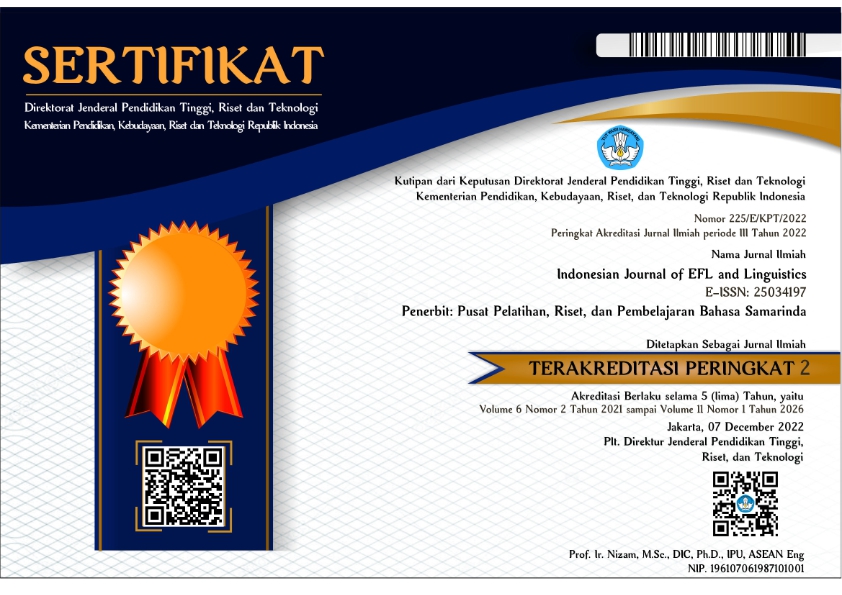
ACCREDITATION
ADDITIONAL MENU

The Indonesian Journal of EFL and Linguistics recognises authorship as both scholarly credit and responsibility for published work. Authorship must accurately reflect substantive contributions, and all listed authors must accept responsibility for the integrity of the manuscript.
Eligibility for Authorship
Each author must satisfy all four conditions: make a substantial contribution to the study’s conception, design, data acquisition, analysis, or interpretation; draft the manuscript or critically revise its intellectual content; approve the final version for publication; and accept accountability for ensuring that concerns about any part of the work are investigated and resolved.
Everyone who meets these conditions must be included. Contributors who make substantial research contributions must have an opportunity to participate in manuscript preparation and approval.
Author Contributions
Manuscripts must include an Author Contributions statement explaining each author’s role. Contributions may include conceptualisation, methodology, investigation, data curation, analysis, and manuscript preparation or revision. Authors may use the Contributor Roles Taxonomy (CRediT) to describe these roles.
A contribution statement supports transparency but does not replace the authorship criteria. All authors must review and agree to the statement before submission.
Corresponding Author
The corresponding author coordinates communication with the journal, verifies authorship information, and ensures that all authors approve submission and subsequent revisions. This author also coordinates responses to editorial questions, including those arising after publication.
Author Order
Authors must collectively agree on their order before submission. Academic rank, institutional position, or supervisory status must not determine inclusion. Any equal-contribution designation must accurately describe the work and be approved by all authors.
For manuscripts arising from student research, authorship must fairly represent the student’s and other contributors’ actual intellectual contributions. Supervision alone does not establish eligibility.
Acknowledgements
People whose assistance does not meet all authorship criteria should be acknowledged, with their permission. Funding, general supervision, administrative assistance, proofreading, or language editing alone does not qualify a person as an author.
Unacceptable Authorship Practices
JELTL does not permit gift, honorary, guest, purchased, or ghost authorship. Individuals must not be included because of reputation, influence, payment, or an expectation of professional favour. Equally, eligible contributors must not be excluded.
No person may be named as an author without their knowledge and consent. Authors must provide accurate names, affiliations, and contact details.
Changes to Authorship
Requests to add or remove authors, change their order, or amend contribution designations after submission must be sent to the editor with an explanation and written agreement from everyone affected, including anyone being added or removed. Changes require editorial approval. Approved changes after publication will be documented through a correction where appropriate.
Authorship Disputes
The journal may pause manuscript processing while an authorship dispute is unresolved. Disputes that require investigation will be referred to the relevant institution, as editors cannot adjudicate competing claims about contributions.
Where a dispute concerns a published article, the journal will assess whether a correction or other editorial action is necessary. An authorship dispute alone does not justify retraction when the findings remain reliable.
Artificial Intelligence and Authorship
Artificial intelligence tools cannot be listed as authors because they cannot accept responsibility for the work. Authors remain responsible for all submitted content, including AI-assisted material.
Authors must disclose substantive use of generative AI in manuscript preparation or research, identifying the tool and its purpose in an appropriate section. AI-generated content must be checked for accuracy, originality, appropriate attribution, and potential bias.
ACCREDITATION
ADDITIONAL MENU

